
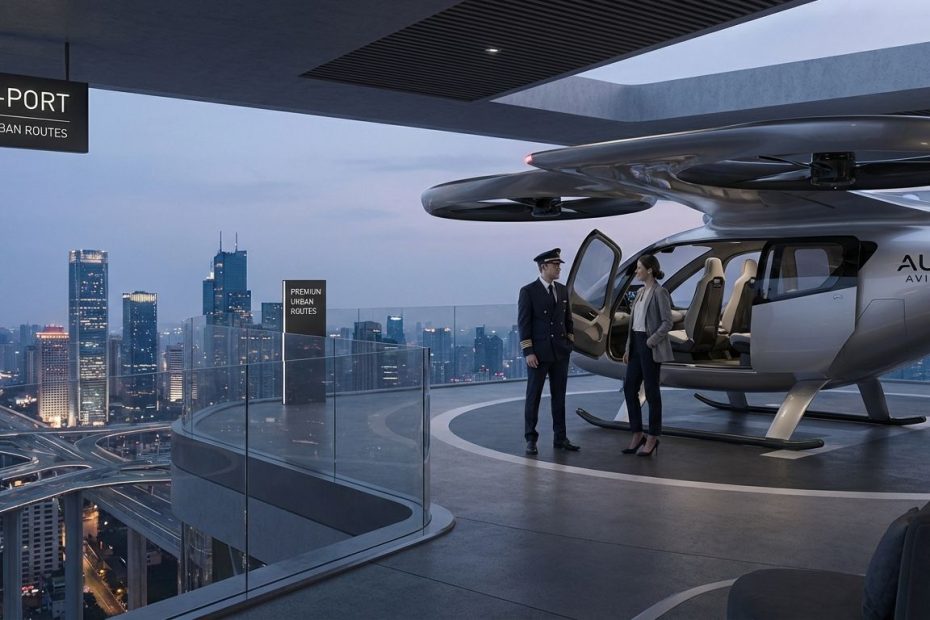
Flying taxis will become real sooner than most people expect, but not as an everywhere, everyday option. You are likely to see narrow, premium routes go live first, with the UAE leading the earliest credible launches and the U.S. scaling later under FAA rule integration and certification pacing.
You are going to get a clear read on what is actually happening, what is marketing, what is blocked by regulation, and what cities must build before “urban air mobility” turns into repeatable service. The focus stays on timelines, safety, noise, infrastructure, pricing, and autonomy, using recent public milestones from regulators and major eVTOL programs. You will also see how to evaluate launch claims like an operator, not like a headline reader.
When Will Flying Taxis Actually Start Carrying Paying Passengers (And Where First)?
If you want the most credible near-term answer, focus on places where three things already align: government sponsorship, an operator willing to run early service, and visible infrastructure work. The UAE checks those boxes more than any other region right now, which is why Dubai and Abu Dhabi keep showing up as “first markets” in serious discussions. When a city can authorize routes, coordinate airspace procedures, and move permitting fast, the odds of actual passenger flights go up sharply.
Dubai has been unusually explicit about timing, tying its aerial taxi program to a 2026 launch window. The Roads and Transport Authority (RTA) also reported a concrete operational milestone in November 2025: a first crewed electric aerial taxi flight between two distinct locations, flying from Margham to Al Maktoum International Airport in 17 minutes during Dubai Airshow 2025. That kind of point-to-point demonstration matters because it looks less like a test hop and more like an early service profile: planned route, defined endpoints, airport adjacency, and repeatable distance.
Abu Dhabi is running in parallel with a different playbook: aircraft plus operations package. Archer’s “Launch Edition” program with Abu Dhabi Aviation (ADA) is designed to deploy an initial fleet, supported by pilots, technicians, engineers, and booking software to stand up early operations. That language is important for you to notice, since it signals a move beyond prototype flight and into operational readiness work, including training, maintenance, dispatch, and local regulator engagement. Whether those flights become broadly available passenger service quickly is still uncertain, but the intent is clearly to start real operations in the UAE ahead of broader global scale.
What Is The Biggest Blocker, FAA Certification, Safety Proof, Batteries, Or Noise?
The biggest blocker remains certification and operational integration, not basic flight capability. Aircraft can fly, demo routes, and post impressive specs, but you cannot sell routine passenger service at scale without regulators approving how the aircraft is designed, maintained, flown, and overseen. When timelines slip, it is usually because certification evidence takes longer than planned, or operational rules are not fully settled for the category.
In the U.S., the FAA’s powered-lift integration work has been a critical step because most eVTOL air taxis fit the powered-lift concept rather than traditional airplane or rotorcraft categories. The FAA published a powered-lift pilot certification and operations final rule in late 2024, with corrections effective January 21, 2025, and an enforcement-discretion period that delayed enforcement until March 20, 2025. For you as a reader, the operational meaning is simple: the FAA has been building the rule structure needed to stand up pilots, instructors, and operating practices for powered-lift aircraft inside the National Airspace System.
Batteries, noise, and performance still matter, but they tend to be second-order blockers compared to certification proof and operating permissions. Battery energy density affects range and payload, battery lifecycle affects operating cost, and battery thermal behavior affects safety case complexity. Noise affects public acceptance and local permissions, which can slow vertiport approvals even after the aircraft is technically ready. You should treat “the biggest blocker” as a rotating constraint that changes by market: in the UAE it is often operational readiness plus local approvals, in the U.S. it is often certification and integration sequencing, and in dense cities it is frequently community acceptance tied to noise and routing.
How Safe Are EVTOL Air Taxis Compared With Helicopters And Small Planes?
You should expect the safety bar to look more like commercial aviation discipline than “new gadget” flexibility. eVTOL air taxis are being positioned for high-frequency operations over populated areas, which means redundancy, fault detection, maintainability, and predictable handling become non-negotiable. The engineering pitch often emphasizes distributed electric propulsion, multiple rotors, and software monitoring, but the practical safety story is built on certification evidence, maintenance programs, pilot training standards, and stable operating corridors.
Comparisons to helicopters come up constantly because helicopters already serve the “vertical lift in cities” use case, and they have a long safety record shaped by hard lessons. Your best way to evaluate safety claims is to ask what failure conditions the aircraft can tolerate while still landing safely, what maintenance intervals look like, and how the operator prevents dispatching an aircraft with a hidden fault. If the public discussion stays stuck on “it has many rotors so it must be safe,” that is not enough. If the discussion includes redundancy philosophy, flight control integrity, battery containment, continued safe flight and landing expectations, and operational limitations in early service, the program is likely thinking like a serious air operator.
Regulators also signal how they expect the industry to behave. The FAA’s powered-lift rule activity is not just paperwork, it is a visible indicator that the U.S. is treating powered-lift operations as a category that needs structured training and operating rules. Early air taxi operations will almost certainly start on constrained routes, with conservative weather minima, conservative load planning, and carefully chosen alternates. That is how aviation scales safely, and you should expect the same pattern here.
How Loud Will Flying Taxis Be In Real Neighborhoods (And Will Cities Allow Them)?
Noise is where many air taxi programs win the engineering argument and still lose the city-permission argument. You can produce a low-noise measurement under a defined test condition and still frustrate neighborhoods if flight frequency is high, if approach paths concentrate over a few blocks, or if hover and transition profiles are not managed carefully. You should evaluate noise claims in operational terms: where the aircraft flies, how often it flies, how it climbs, how it descends, and what the vertiport procedures require.
On the regulatory side, Europe has treated air taxi noise as a first-order topic earlier than many people realize. EASA published what it described as the first worldwide proposal for assessing and limiting air taxi noise, with Environmental Protection Technical Specifications aimed at certain eVTOL configurations. That move matters because it tells you where permitting conversations are headed: cities and regulators are going to want standardized, comparable noise assessments, not just manufacturer marketing numbers.
On the industry communications side, companies have been trying to anchor expectations with test-backed claims and modeling. Joby has published material describing NASA-backed acoustic testing and separate work on ambient noise modeling, aiming to translate “lab-style” noise metrics into what a neighborhood experiences over time. When you read noise coverage, watch for whether it addresses frequency and flight tracks. Cities can accept a quiet aircraft and still restrict operations if the route design creates a constant presence.
How Much Will An Air Taxi Ride Cost, And Will It Ever Be Uber Cheap?
At launch, you should plan for premium pricing. The first commercially viable routes are the ones where time savings are obvious, demand is predictable, and passengers tolerate higher fares, airport transfers and high-value business corridors are typical candidates. Early fleets will be small, aircraft utilization will be ramping, maintenance programs will be conservative, and infrastructure costs will be amortized over fewer flights. All of that pushes price up.
Cost comes down only when utilization goes up and unit costs fall. You should watch three levers: aircraft availability (dispatch reliability), maintenance labor hours per flight hour, and battery replacement economics. If the aircraft spends too much time on the ground for inspections or charging, unit economics collapse quickly. If the battery cycle life is shorter than planned, direct operating cost rises and reliability drops, which also increases price because the operator cannot confidently schedule dense service.
“Uber cheap” is a long-range outcome that requires network density, fast turn times, mature maintenance, and streamlined vertiport operations. You can still get strong value without mass-market pricing if you use the service where it beats ground travel reliably. The realistic near-term win is not replacing every car trip, it is replacing the trips where time certainty has real value.
Where Will They Land, What Is A Vertiport, And Are Any Being Built Now?
A vertiport is the ground system that determines whether air taxis stay a demo or become a schedule. It is not just a landing pad, it is passenger flow, safety areas, fire and rescue coordination, charging or energy management, approach and departure procedures, security expectations in some locations, and neighborhood impact management. When you see “vertiport plans” without visible progress on permitting, safety design, and operational procedures, treat it as an early signal rather than readiness.
In the U.S., the FAA has been laying groundwork through its Advanced Air Mobility infrastructure work, including guidance that treats vertiports within the broader heliport structure while adapting design assumptions for eVTOL operations. The practical takeaway for you is that infrastructure is being standardized step by step, and that reduces risk for cities and developers that want to build facilities without guessing what regulators will accept later.
Dubai has shown more direct momentum on construction than most markets, with the RTA stating that Skyports Infrastructure had completed 60 percent of construction of the first aerial taxi vertiport near Dubai International Airport (DXB). That is not a promise on a slide deck, it is a status update tied to a location and a build percentage. When you combine visible construction progress with a crewed point-to-point flight milestone, you get a more credible picture of near-term operability than most cities can currently demonstrate.
Will Flying Taxis Be Piloted Or Autonomous, And How Soon Could Autonomy Happen?
You should expect piloted service first in most markets, even where autonomy is the end goal. Piloted operations reduce certification complexity, reduce public acceptance friction, and simplify incident response in the early phase. They also allow operators to build real-world operating data under controlled risk, which helps the next steps in automation and scale.
Autonomy programs are moving, but the timeline is longer and the bar is higher. Wisk, a Boeing subsidiary, has been explicit about pursuing autonomous passenger flight, and it announced the first flight of its Generation 6 autonomous eVTOL, describing it as part of its certification path. Wisk has also publicly positioned 2030 as a target timeframe for commercial operations, which aligns with how long it takes to certify not just an airframe but an autonomy system, detect-and-avoid capability, and an operational concept that regulators will accept for passenger service.
You should also separate “autonomous aircraft capability” from “autonomous urban service at scale.” Even if the aircraft can fly without a pilot, the system still needs airspace integration, contingency management, communications, and ground operations that keep risk controlled. Autonomy will arrive in steps, with heavy oversight and conservative operating envelopes before any broad expansion.
What Has To Be True For Urban Air Mobility To Scale Beyond A Few Showcase Routes?
Scaling requires operational repetition, not one-off demos. You need aircraft that can fly many cycles per day with predictable maintenance, predictable energy turnaround, and stable dispatch reliability. Without that, you cannot build a schedule that passengers trust, and you cannot generate the revenue density that makes routes sustainable. This is where many programs will either mature into transportation businesses or stay stuck in “technology showcase” mode.
You also need airspace procedures that do not overload local air traffic systems. Early routes will likely be designed to reduce complexity: clear corridors, known altitudes, standard arrivals and departures, and tight coordination around airports. Over time, scaling requires procedural standardization that lets more flights operate without turning every trip into a bespoke ATC event. Your signal to watch is whether operators can publish repeatable procedures and execute them reliably across weather variability and traffic conditions.
Community permission is the third requirement, and it is more operational than political. If flight tracks concentrate noise, if vertiports create traffic problems, or if operations look unpredictable, cities will restrict growth. The programs that scale will treat community impact like an operating metric: measure complaints, adjust procedures, manage hours, and build trust through consistency. This is not optional, since local acceptance determines where you can build vertiports and how frequently you can fly.
When Will Flying Taxis Start In Real Cities?
- Earliest credible launches: UAE-focused services targeting 2026
- U.S. scale depends on FAA certification and powered-lift operating integration
- Expect premium routes first, broad adoption later
Stay Ready For What Comes Next
You should treat flying taxis as a near-term reality in limited corridors, not a science project and not instant mass transit. The UAE is building a credible early lead with a public 2026 target, a documented crewed point-to-point eVTOL flight milestone in November 2025, and visible vertiport construction progress near DXB. In the U.S., the FAA has already taken meaningful steps on powered-lift rule integration, which is necessary groundwork for commercial eVTOL operations, even if timelines remain gated by certification proof. Pricing will start premium, noise and routing will decide local permissions, and autonomy will arrive later on a measured schedule. If you track infrastructure readiness, certification progress, and route-level operations, you will see the real story months before the headlines catch up.

Robert Wilkos is the co-founder of VIPJets.com and a private aviation executive leading luxury charter services through a global network of 10,000+ aircraft. He champions rigorous Wyvern/ARGUS safety standards, 24/7 concierge support, and flexible options like the 25-Hour Jet Card, along with ground and air-medical transport.