

Private jets became mobile productivity centers by transforming otherwise unproductive travel time into focused work environments where executives can conduct confidential meetings, access high-speed connectivity, and operate without the interruptions and delays inherent in commercial aviation. This shift has redefined business travel from a necessary inconvenience into a strategic asset that directly contributes to corporate performance.
In this article, you will discover how the modern private jet cabin functions as an airborne office, what technology enables this transformation, and why 66% of business aviation users report higher productivity in the air than in their own offices. You will learn the quantifiable return on investment that companies achieve, the specific features that make these aircraft so effective as workspaces, and how to evaluate whether this model makes financial sense for your organization.
How Do Private Jets Save Executives Time?
Private jets save executives time by eliminating the inefficiencies built into commercial air travel, from lengthy airport procedures to indirect routing through hub-and-spoke systems. The time savings are not marginal—they are substantial and measurable. Studies consistently show that private aviation saves between two and five hours per flight segment compared to commercial alternatives. A 2013 NEXA study reported time savings of 50 to 70 percent when flying private compared to commercial flights, and a 2018 European Business Aviation Association study found that private jet users saved an average of 127 minutes on each flight. [1] [2] [3]
The most immediate time savings come from airport procedures. When you fly commercial, you must arrive 90 to 120 minutes before departure to navigate parking, terminal transfers, security lines, and boarding processes. With private aviation, you arrive at a dedicated Fixed-Base Operator facility just 15 minutes before departure. You park steps from the aircraft and board immediately after a streamlined security check. This transformation alone saves two to three hours per trip. The cumulative effect over dozens of trips per year is staggering—hundreds of hours returned to productive use. [1]
The second major source of time savings is route efficiency. Commercial airlines operate on hub-and-spoke systems that frequently require connections for reaching secondary markets. This model significantly extends travel time and introduces multiple failure points where delays can cascade. Private jets can access over 5,000 airports in the United States alone—roughly ten times the number served by commercial carriers. This capability allows you to land closer to your actual meeting destination, eliminate connecting flights, and reduce ground transportation time. What might require a three-day journey commercially can often be completed in a single day with private aviation. [1]
When a CEO needs to visit three manufacturing facilities in different mid-sized cities, the difference becomes stark. Commercial travel would require multiple connections, overnight stays, and potentially several days to complete the itinerary. With private aviation, the same trip can be accomplished in a single day, with the executive returning home that evening. This is not about luxury—it is about operational efficiency and the ability to maintain momentum in fast-moving business situations.
What Makes a Private Jet Cabin an Effective Workspace?
A private jet cabin functions as an effective workspace because it provides the three elements that are increasingly rare in modern business travel: privacy, connectivity, and control. These are not luxury features; they are operational requirements for executives handling sensitive information and making time-critical decisions. The cabin becomes a secure extension of your corporate headquarters, allowing work to continue uninterrupted at 40,000 feet.
Privacy is the foundation of the flying office. You can conduct confidential meetings with your team, discuss sensitive business strategies, make private phone calls, and review proprietary documents without concern that competitors or unauthorized parties might overhear. This level of confidentiality is impossible on a commercial flight, where you are surrounded by strangers and every conversation is potentially compromised. The private cabin eliminates this risk entirely. You can spread out financial statements, discuss merger negotiations, or review personnel decisions without worrying about who might be looking over your shoulder or listening to your conversation. [1]
Connectivity has evolved dramatically in recent years. Modern private jets offer high-speed internet through either air-to-ground systems or satellite-based connections. Air-to-ground systems typically provide speeds around 10 Mbps and work well for domestic flights over land. Satellite systems offer higher speeds, with Ku-band connections delivering 3 to 12 Mbps and Ka-band systems reaching 20 to 30 Mbps or higher. These speeds are sufficient for video conferencing, large file transfers, and collaborative work with your team on the ground. [4] [5]
The reliability of these connections has improved substantially. Honeywell’s JetWave system offers speeds up to 15 Mbps, providing a fast and reliable internet solution that can be experienced at 40,000 feet. This level of connectivity means you can participate in board meetings via video conference, review and edit documents in real time with colleagues on the ground, and respond to urgent emails without delay. The aircraft is no longer a disconnected bubble—it is a fully integrated node in your corporate network. [6]
Control over the environment is the third critical element. You determine who is on the aircraft, when you depart, and how the cabin is configured. You can spread out documents across tables, use multiple screens, and arrange seating to facilitate team discussions. The lighting, temperature, and noise levels are all optimized for focused work. This level of control transforms the aircraft from a means of transportation into a mobile boardroom where your most important work can be accomplished.
The physical workspace itself is designed for productivity. Modern business jets feature conference tables, ergonomic seating, multiple power outlets, and dedicated spaces for different work modes. You can conduct a strategy session at the conference table, then move to a private seat for focused individual work, then shift to a lounge area for informal discussions with your team. This flexibility is impossible in a commercial cabin, where you are confined to a single seat with minimal workspace.
Can You Really Be More Productive on a Private Jet Than in Your Office?
You can be more productive on a private jet than in your office, and the data supports this claim. A study by the No Plane No Gain advocacy group found that 66% of individuals report being more productive on a business aircraft than they are in their own office. [7] This finding may seem counterintuitive, but it reflects the reality of modern executive work environments, where interruptions are constant and focused time is scarce.
The private jet cabin offers something that is increasingly difficult to find in a traditional office: uninterrupted time. There are no colleagues stopping by your desk, no impromptu meetings pulling you away from critical work, and no phone calls from internal stakeholders demanding immediate attention. The aircraft becomes a sanctuary for deep work, where you can focus on strategic planning, financial analysis, or preparation for high-stakes negotiations without distraction. The forced disconnection from the daily operational chaos of the office creates space for the kind of thinking that executives need to do but rarely have time for.
This productivity advantage extends to team travel. When multiple executives fly together, the aircraft becomes a mobile conference room where collaborative work continues uninterrupted. You can conduct strategy sessions, debrief after client meetings, or make collective decisions on time-sensitive opportunities. The shared travel time becomes productive work time, rather than dead time spent waiting in airports or sitting in cramped commercial seats unable to have confidential conversations. [1]
The reduction in travel fatigue also contributes to productivity. Commercial travel imposes cumulative stress through crowds, uncomfortable seating, irregular meals, and exposure to illness in confined public spaces. Private aviation minimizes these stressors through customized cabin environments, proper seating and lighting, and the ability to maintain normal routines. You arrive at your destination ready to perform, rather than requiring recovery time before an important meeting. [1]
The psychological benefit of reduced stress should not be underestimated. When you eliminate the anxiety of potentially missing connections, the frustration of security line delays, and the physical discomfort of cramped commercial seating, you preserve mental energy for the work that actually matters. You step off the aircraft focused and prepared, not exhausted and irritated.
What Is the Financial Return on Investment for Using Private Jets?
The financial return on investment for using private jets is substantial when you properly account for the value of executive time and the productivity gains that result from efficient travel. For a company with executives flying 300 hours annually, the strategic use of business aviation can unlock an estimated $2.4 million in productivity gains each year. This figure reframes the conversation from cost to value, showing that private aviation is not an expense but an investment in executive efficiency. [7]
The calculation is straightforward. The median S&P 500 CEO has a total compensation of approximately $17.1 million. When you divide this by the roughly 3,250 hours that CEOs work annually—based on a Harvard study finding that CEOs work an average of 62.5 hours per week including weekends and vacation days—you arrive at an hourly value of $5,262. Using a conservative estimate of 1.5 hours saved for every hour flown, an executive flying 300 hours per year reclaims 450 hours of productive time. Multiply those 450 hours by the hourly value, and you reach $2.4 million in annual productivity gains. [7] [8] [9]
This calculation only accounts for time saved. It does not factor in the additional productivity from working uninterrupted in a private cabin, the ability to conduct confidential meetings en route, or the reduced fatigue that allows executives to perform at peak levels upon arrival. When you include these benefits, the true productivity gain is higher. The business case for corporate aviation rests on this foundation: it converts a travel liability into a strategic asset.
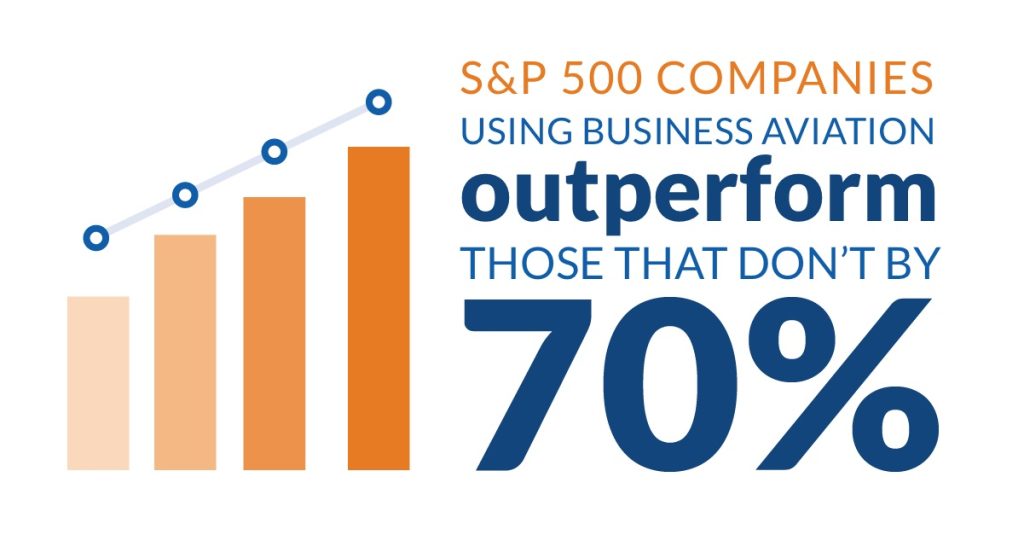
The return extends beyond individual productivity to corporate performance. Multiple studies have shown a correlation between the use of business aviation and superior financial results. S&P 500 companies that use business aviation outperform those that do not by 70%, and business aircraft users outperform non-users by 23% in revenue growth. [10] This does not mean that buying a jet automatically makes a company successful, but it indicates that high-performing, well-managed companies recognize the strategic value of efficient executive travel.
The correlation makes sense when you consider the operational advantages. Companies that use business aviation can respond faster to opportunities, maintain closer relationships with geographically dispersed clients and operations, and deploy leadership talent more efficiently. These advantages compound over time, contributing to sustained competitive advantage and superior financial performance.
How Do You Calculate the True Cost of Commercial Travel?
You calculate the true cost of commercial travel by accounting for the opportunity cost of executive time, not just the ticket price. When a C-suite executive earning $5,262 per hour spends four hours navigating a commercial airport experience—two hours before the flight and two hours dealing with delays and ground transportation afterward—the opportunity cost is $21,048 for a single executive on a single trip. For a team of four executives, that figure approaches $85,000. This is the hidden tax that commercial travel imposes on your most critical talent. [7] [8]
The comparison becomes even more stark when you consider multi-day trips. Commercial travel often requires overnight stays, per diems, and additional meal expenses. A three-day trip that could be completed in one day with private aviation incurs hotel costs, extends time away from the office, and delays other important work. When you add these indirect costs to the opportunity cost of executive time, the incremental expense of private aviation often pays for itself through efficiency gains alone.
Trip consolidation is another source of value. With private aviation, you can visit multiple cities in a single day, completing itineraries that would require several days of commercial travel. This allows more client interactions per week and more time in the office between trips. For companies with executives traveling frequently to secondary markets, this consolidation effect can be the difference between winning and losing competitive opportunities. [1]
Consider the real-world example of a US-based real estate developer with $100 million in annual revenue. With less than half of their frequently traveled routes offering direct commercial service, the average flight segment was taking 6.5 hours, and the average business trip was four days long. By implementing a business jet, they projected a 50% reduction in travel time with 640 annual flight hours. The jet allowed their teams to visit two or three destinations in a single day, access secondary markets and remote locations, and get in front of more clients. The investment in the aircraft was a direct investment in their ability to execute their growth plan. [11]
Cost Comparison: Commercial vs. Private Aviation
- Commercial Travel: Low ticket cost, high opportunity cost from delays and inefficiency
- Private Aviation: Higher direct cost, dramatically lower opportunity cost
- Executive Time Value: $5,262/hour for median S&P 500 CEO
- Time Saved Per Flight: 2-5 hours on average, up to 127 minutes per segment
- Annual Productivity Gain: $2.4M for 300 flight hours at executive rates
- Hidden Commercial Costs: Hotels, per diems, extended trips, lost productivity, recovery time
- Trip Consolidation: Multi-day commercial trips completed in single day with private aviation
What Technology Features Enable the Flying Office?
The technology features that enable the flying office have advanced significantly in recent years, transforming the private jet cabin from a comfortable but disconnected space into a fully-equipped mobile workspace. The foundation of this transformation is reliable, high-speed internet connectivity, but the technology stack extends far beyond basic WiFi to include cabin management systems, communication tools, and entertainment platforms that support both work and well-being during flight.
Internet connectivity comes in two primary forms: air-to-ground and satellite-based systems. Air-to-ground systems use an antenna installed at the base of the aircraft fuselage to receive signals from WiFi towers on the ground, similar to how cell phones operate. These systems typically provide speeds around 10 Mbps and work well for domestic flights over land, though they are limited to within 50 miles of shore. The technology works by picking up network signals from cell towers as the aircraft flies over them, retransmitting those signals to WiFi access points installed throughout the cabin walls. [4] [5]
Satellite-based systems offer broader coverage and higher speeds, making them the preferred choice for international travel and flights over water. Ku-band satellite connections operate in the 12 to 18 GHz frequency range and deliver download speeds of 3 to 12 Mbps, sufficient for email, messaging, and light remote work. Ka-band systems operate in the 26.5 to 40 GHz range and provide faster speeds of 20 to 30 Mbps or more, enabling video conferencing, media viewing, and collaborative work with multiple team members. Both types of satellite connections are the only options when you travel internationally or over oceans, because different countries’ connectivity infrastructure varies and air-to-ground systems cannot simply hop between different national networks. [4] [5]
Cabin management systems give you control over every aspect of the environment. Modern systems allow you to adjust lighting, temperature, window shades, and entertainment options through touchscreen interfaces or mobile apps. Some aircraft offer voice-control technology, letting you manage cabin settings hands-free through custom applications. Bombardier, for instance, offers upgraded voice-control cabin technology via a custom app that gives passengers control of lighting, temperature, and audio, all by voice command. These systems create an environment optimized for your specific work needs, whether you require bright lighting for document review or dimmed settings for focused screen work. [12]
Communication tools have also improved. High-quality audio systems enable clear conference calls, and video conferencing capabilities allow face-to-face meetings with colleagues and clients on the ground. The combination of reliable connectivity and proper audio-visual equipment means you can participate in critical meetings from the air with the same effectiveness as if you were in your office. This capability is particularly valuable for executives who need to stay connected to rapidly developing situations or time-sensitive decisions.
Advanced air quality and purification systems ensure that the cabin environment supports sustained cognitive performance. These systems filter and refresh cabin air more frequently than commercial aircraft, reducing fatigue and maintaining alertness during long flights. The combination of clean air, proper lighting, comfortable temperature, and low noise levels creates conditions conducive to focused work over extended periods.
How Do Companies Justify the Cost of Business Aviation?
Companies justify the cost of business aviation by measuring the tangible business outcomes that result from efficient executive travel, not by comparing ticket prices. The justification rests on three pillars: time value of executives, opportunity capture, and strategic agility. When properly analyzed, many companies find that private aviation pays for itself through these combined efficiency gains, particularly for executive teams making multiple trips to secondary markets. [1]
The time value calculation is the starting point. When you multiply the number of hours saved by the hourly value of the executives using the aircraft, you quantify the productivity gain in dollar terms. For a C-suite team with a combined hourly value of $10,000, saving five hours on a trip recovers $50,000 in productive time. This often exceeds the incremental cost of private travel over commercial alternatives. The aircraft becomes a tool for preserving your most valuable resource: leadership attention. [1] [7]
Opportunity capture is the second justification. The ability to reach customers or partners faster than competitors can secure deals that might otherwise be lost, generating revenue that would not exist with commercial travel constraints. When a potential client needs a face-to-face meeting within 24 hours, the company that can get its team there first has a significant advantage. Private aviation provides this competitive edge, allowing you to respond to opportunities with speed that commercial schedules cannot match. [1]
David MacNeil, founder of WeatherTech, stated this principle clearly: “Our planes get us in front of our customers. That hands-on approach has been a significant factor in the growth of our company.” [7] The aircraft is not a perk—it is a sales tool that enables face-to-face relationships in an era when personal connection still matters for high-value transactions.
Strategic agility is the third pillar. Business conditions change rapidly, and the ability to deploy key personnel quickly can make the difference between success and failure. Private aviation provides unmatched scheduling flexibility, allowing you to arrange flights with minimal notice (often under four hours), adjust departure times as meetings shift, wait for delayed passengers without penalty, and change destinations mid-trip as priorities shift. This operational agility transforms travel from a rigid constraint into a strategic enabler. [1]
Companies that use business aviation also benefit from reduced overnight costs. When you can complete a trip in one day instead of three, you eliminate hotel stays, per diems, and extra meal expenses. These savings partially offset the higher cost of private aviation. More importantly, executives spend less time away from home and have more time in the office between trips, improving both work-life balance and operational effectiveness. [1]
A study of Asia’s business leaders found that 87% estimated productivity improvements of between 25% and 50% when traveling on business jets. [13] This is not a marginal gain—it is a fundamental transformation in how travel time is utilized. When you can turn a six-hour commercial journey into a two-hour private flight where you accomplish meaningful work, you have not just saved four hours; you have converted six hours of lost time into two hours of productive time, an eight-hour swing in value.
What Are the Operational Benefits Beyond Productivity?
The operational benefits of business aviation extend beyond direct productivity gains to include enhanced security, improved health and safety, and better work-life balance for executives. These factors may be harder to quantify than time savings, but they contribute significantly to the overall value proposition and should be part of any comprehensive evaluation.
Security is a growing concern for executives at major corporations. Private aviation provides a controlled environment where you know exactly who is on the aircraft and who has access to your travel plans. This is particularly important for executives handling sensitive negotiations, proprietary information, or high-stakes transactions where confidentiality is critical. The risk of industrial espionage or unauthorized disclosure is significantly reduced when you control the entire travel environment.
Health and safety considerations have become more prominent in recent years. Private aviation reduces exposure to illness by limiting contact with large crowds in airports and on commercial flights. The cabin air quality is superior, with more frequent air changes and advanced filtration systems. The ability to maintain normal sleep schedules, eating routines, and hydration levels contributes to better health outcomes for executives who travel frequently. These factors reduce sick days and maintain consistent performance levels.
Work-life balance is another significant benefit. When you can complete a multi-city trip in one day instead of three, you spend more nights at home with your family. This is not just a quality-of-life issue—it is a retention issue for top executive talent. Companies that enable their leaders to fulfill their professional responsibilities without sacrificing their personal lives have a competitive advantage in attracting and retaining the best people.
The flexibility to adjust schedules also reduces stress. If a meeting runs long, the aircraft waits. If a meeting is canceled, you can depart early. This control over your schedule eliminates the anxiety of rushing to catch a commercial flight or the frustration of being stuck in a city because you missed your connection. The psychological benefit of this control contributes to better decision-making and sustained performance over time.
How Do You Determine If Private Aviation Makes Sense for Your Organization?
You determine if private aviation makes sense for your organization by conducting a comprehensive analysis of your executive travel patterns, calculating the opportunity cost of current inefficiencies, and projecting the productivity gains that would result from more efficient travel. This analysis should be data-driven and focused on business outcomes, not perceptions of luxury or status.
Start by documenting your current travel patterns. How many trips do your executives take annually? What routes do they fly? How much time do they spend in airports and on layovers? How often do trips require overnight stays that could be eliminated with more efficient travel? This baseline data allows you to quantify the current state and identify the opportunities for improvement.
Calculate the opportunity cost of executive time. Use actual compensation data to determine the hourly value of the executives who would use the aircraft. Multiply this by the hours currently lost to inefficient travel. This gives you a clear picture of the hidden cost you are already paying through commercial travel inefficiency.
Project the productivity gains. Based on the time savings data from business aviation studies, estimate how many hours would be reclaimed through private aviation. Multiply this by the hourly value of your executives to quantify the productivity gain. Compare this to the cost of private aviation, whether through ownership, fractional programs, or charter.
Consider the strategic benefits. Are there markets you are not serving effectively because of travel constraints? Are there competitive opportunities you are missing because you cannot deploy your team quickly enough? Are there client relationships suffering because face-to-face visits are too time-consuming with commercial travel? These strategic factors may be harder to quantify but are often the most important drivers of value.
Evaluate different access models. Full ownership, fractional ownership, jet cards, and on-demand charter each have different cost structures and operational characteristics. The right model depends on your annual flight hours, route patterns, and flexibility requirements. Many companies find that a combination of models—fractional ownership for predictable routes and on-demand charter for occasional needs—provides the optimal balance of cost and flexibility.
How Much Time Do Private Jets Save?
Private jets save 2-5 hours per flight segment compared to commercial travel by eliminating airport wait times, security delays, and layovers, providing direct access to 5,000+ airports, and allowing executives to arrive just 15 minutes before departure.
Your Airborne Advantage
The transformation of private jets into mobile productivity centers represents a fundamental shift in how leading companies approach executive travel. You now understand that the value proposition extends far beyond comfort or convenience—it is about preserving executive focus, enabling strategic agility, and converting travel time into productive work hours. The data is clear: companies that use business aviation strategically see measurable gains in productivity, competitive positioning, and financial performance.
The question is not whether your executives can afford to fly private, but whether your company can afford for them not to when the opportunity cost of inefficient travel is properly calculated. When 66% of users report being more productive on a business aircraft than in their own office, when time savings average 2-5 hours per flight, and when the annual productivity gain can reach $2.4 million for a mid-level user, the business case becomes compelling. The flying office is not a luxury; it is a strategic tool for companies that value their leadership’s time and recognize that in business, timing often determines success.
The companies that will thrive in the coming years are those that recognize this reality and make strategic investments in executive efficiency. Private aviation is one of those investments—not because it is prestigious, but because it works. The data supports it, the executives who use it report it, and the financial performance of companies that embrace it confirms it. Your next step is to conduct your own analysis, using your actual travel data and executive compensation figures, to determine whether the flying office model makes sense for your organization. The answer may surprise you.
References
[2] Solairus Aviation. “Productivity While Flying Private.” 18 July 2016.
[3] European Business Aviation Association. “Private Aviation Time Savings Study.” 2018.
[4] Magellan Jets. “Private Jet WiFi: A Guide To In-Flight Connectivity.” 3 January 2024.
[5] SHY Aviation. “High-Speed WiFi: Staying Connected on a Private Jet.” 14 May 2024.
[6] Honeywell Aerospace. “Up Close with Honeywell’s High Speed Internet Solution JetWave.”
[7] Robert Wilkos. “Beyond Time Savings: The $2.4 Million Annual Productivity Gain from Strategic Aviation Use.” 12 November 2025.
[8] Harvard Law School Corporate Governance. “CEO Compensation Data.” 2024.
[9] Harvard Business Review. “How CEOs Manage Time Study.” 2018.
[10] No Plane No Gain. “Enhanced Productivity Study.” Business Aviation Performance Research.
[11] AvBuyer. “Measuring Productivity of BizAv: Who Should Use Your Jet?” 29 October 2025.
[12] Fly Volato. “A Look Inside the Cabin: Private Jet Interiors.” 30 July 2024.

Robert Wilkos is the co-founder of VIPJets.com and a private aviation executive leading luxury charter services through a global network of 10,000+ aircraft. He champions rigorous Wyvern/ARGUS safety standards, 24/7 concierge support, and flexible options like the 25-Hour Jet Card, along with ground and air-medical transport.