
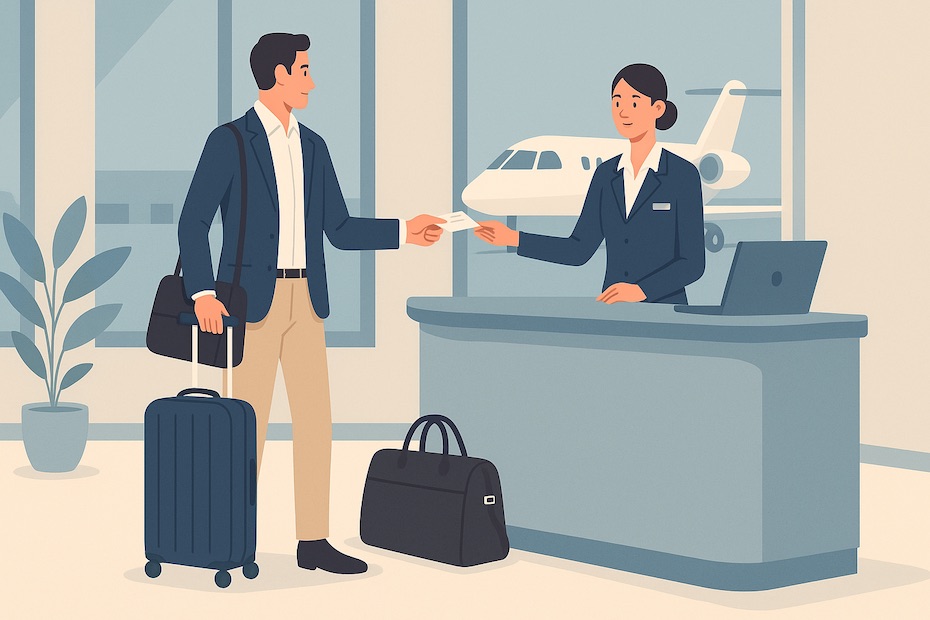
Flying private for the first time eliminates the hassle of commercial travel and replaces it with personalized luxury, streamlined boarding, and flexible scheduling.
This guide prepares you for what really happens—from your arrival at the FBO to what services you’ll receive onboard. You’ll learn how private aviation works behind the scenes and what behaviors help you get the most out of your first private jet experience.
What arrival time should you plan for your first private jet flight?
You should arrive 15 to 30 minutes before your scheduled departure.
Unlike commercial airlines, private jets don’t require extended pre-boarding windows or security lines. You’ll arrive at a Fixed-Base Operator (FBO), not a crowded terminal, and your aircraft crew will be waiting. Most FBOs offer valet parking or curbside drop-off with immediate check-in, meaning your total pre-departure experience can be less than 20 minutes.
Still, don’t cut it too close. Your crew may need to finalize routing details or weather adjustments, and catering or baggage checks can occasionally cause brief delays. It’s smart to arrive at least 20 minutes early to stay ahead of any last-minute logistics.
What should you wear, and what documentation will you need?
Private aviation is informal in process, but refined in appearance. Dress accordingly.
There’s no enforced dress code, but comfort with polish is expected. For business trips, opt for a smart casual look—blazer or dress shirt without a tie, loafers or clean sneakers. For leisure, athleisure or upscale resortwear works well. Many first-time travelers wear shoes that are easy to slip off and on during boarding.
When it comes to documentation, bring a valid government-issued ID for domestic flights. If you’re flying internationally, a valid passport is mandatory. Your operator handles most other documentation—manifests, customs clearance, and visas—on your behalf. You’ll rarely deal with paperwork after arriving at the FBO.
How much luggage can you bring on a private jet?
Luggage allowances vary by aircraft size, not by ticket type.
Light jets accommodate about 5–6 carry-ons total, while midsize and heavy jets offer space for multiple full-size suitcases. For reference, a Citation XLS+ can typically hold 4 medium suitcases, 3 carry-ons, and a few garment bags without issue. Larger jets like a Gulfstream G450 have dedicated baggage compartments that rival commercial first-class hold space.
You won’t deal with lost luggage or delayed delivery. Your bags are typically loaded in your presence and handed back directly at arrival. Just let the operator know if you’re bringing golf clubs, skis, or odd-sized gear—many aircraft can accommodate them with advance planning.
What amenities and services should you expect onboard?
Expect custom comfort and discreet attention—this is where private aviation separates itself.
Every aircraft is different, but standard amenities include reclining leather seats, temperature control, mood lighting, and full Wi-Fi access. You’ll often have access to in-flight entertainment systems, satellite phones, and USB charging. Onboard catering can include anything from champagne and charcuterie to fully customized meals if requested ahead of time.
Crew members are trained to provide personalized, professional service without intrusion. They’ll offer brief safety instructions, then stay available to serve drinks, food, and any other requests. You dictate the atmosphere—quiet and restful, or productive and alert.
Can you bring pets, kids, or colleagues?
Yes, but each group requires a different type of coordination.
Most private charters are pet-friendly. Dogs and cats can ride in the cabin with you rather than being crated below. You’ll need to notify the operator in advance to confirm aircraft policy and cleaning fees. For international flights, proper documentation and pet passports may be required.
Kids are welcomed too—many operators offer child seats, snacks, or toys if requested. If you’re flying with business associates, make sure all passengers are on the manifest and understand the expected etiquette for onboard interaction.
Flying with others can impact seating arrangements and food choices, so overcommunicate with your charter concierge ahead of time to avoid friction during the flight.
What happens at the FBO before and after your flight?
The FBO experience is the first taste of private air travel—and it’s designed for privacy and speed.
At check-in, you’ll be greeted by name and often escorted directly to your plane. While you wait, you’ll enjoy a private lounge with complimentary drinks, snacks, Wi-Fi, and concierge services. There are no TSA lines, random screenings, or gate announcements—your crew will come get you when it’s time to board.
After landing, ground transport can be arranged to pull up right next to the aircraft. Your bags will be offloaded and placed directly into your car or SUV. If you’re connecting via commercial airline or helicopter, the FBO will coordinate the transition seamlessly.
How does flying private compare to first class?
Private aviation offers control. First class offers comfort—on someone else’s schedule.
In first class, you receive quality seats, better meals, and priority boarding—but you’re still locked into fixed routes, TSA lines, and shared cabin space. With private, you dictate the schedule, choose your departure airport, avoid delays, and control who boards with you.
Costs are higher—expect $4,000 to $20,000 per flight hour—but you gain time, productivity, and peace of mind. For executives, entertainers, and high-stakes professionals, the ROI goes far beyond luxury. It’s about precision and predictability.
What to Expect When Flying Private for the First Time
- Arrive 15–30 minutes early at a private terminal
- No TSA lines—walk directly onto your aircraft
- Wear smart casual clothing; bring valid ID or passport
- Expect catering, Wi-Fi, and full luggage handling
- Pets and kids welcome—notify ahead of time
- Costs range $4K–$20K/hour depending on aircraft
In Conclusion
Flying private for the first time resets your expectations. You’ll bypass everything that slows down commercial travel and step into a flight experience built entirely around your preferences. From seamless FBO check-ins and custom onboard services to luggage handled with care and direct scheduling, your journey becomes effortless, efficient, and personal. Once you experience it, you’ll understand why so many fliers never look back.

Robert Wilkos is the co-founder of VIPJets.com and a private aviation executive leading luxury charter services through a global network of 10,000+ aircraft. He champions rigorous Wyvern/ARGUS safety standards, 24/7 concierge support, and flexible options like the 25-Hour Jet Card, along with ground and air-medical transport.