
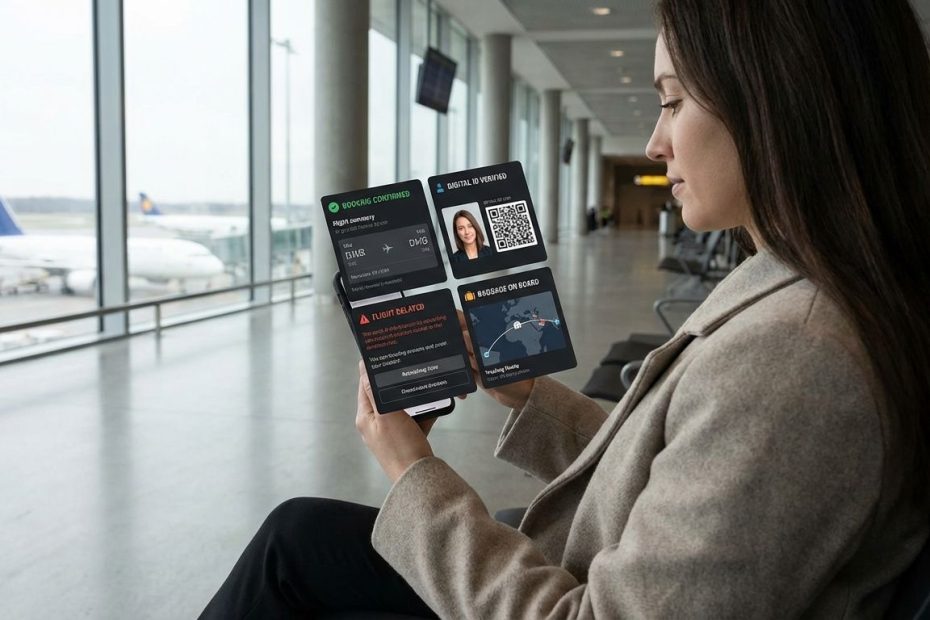
A “digital airline” is an airline that treats your trip as a single data-connected product, priced, sold, serviced, and delivered through software, not disconnected systems. You feel it in faster booking, richer offers, touchless identity, smarter disruption handling, and tighter baggage visibility.
This article breaks down what’s really changing across booking, airport, and baggage, using the same questions travelers keep asking in real forums and help channels. You’ll walk away knowing why prices don’t match across channels, what NDC and ONE Order actually fix, where digital ID works today, and which baggage upgrades are producing measurable results.
How Are Airlines Using AI To Change Ticket Prices, And Is It “Personalized Pricing”?
Airline pricing has always been variable, you already know that if you’ve watched fares move between morning and evening, or after a big event fills seats. What’s changing is the speed and granularity of decisioning, with AI systems tuning fares continuously, reducing the gap between “pricing team intent” and “what’s actually live in market.” When that AI is connected to modern retailing, it can price not just the seat, but the full offer, seat, bags, flexibility, upgrades, lounge access, onboard connectivity, and priority services, as one package.
Public reporting has gone further, describing airline trials where AI targets a “willingness to pay” ceiling at the individual level. Delta’s rollout has been described in exactly those terms, with testing expanding from a small percentage of fares and plans to grow materially over time. When you see that kind of phrasing, you should treat it as a signal: airlines want price optimization that behaves less like static fare filing and more like e-commerce yield, with the airline deciding which offer and price to present at that moment.
For you as a traveler, the practical impact is less philosophical and more operational. Your best defense is controlling the variables you can control: stay consistent on trip attributes when comparing, avoid mixing channels mid-flow, and price the total trip cost (seat, bags, change terms, and onboard connectivity) instead of chasing a base fare that only exists because the bundle is stripped. AI-based pricing can also mean faster reaction to demand spikes, which compresses the window where “wait a day” used to work, so disciplined comparison becomes more valuable than gut-feel timing.
Why Do Prices And Perks Look Different In Airline Apps Vs Google Flights Or OTAs, And What Is NDC?
You’re seeing mismatched prices and bundles because the industry is splitting into two commercial worlds that still overlap. One world is legacy distribution: filed fares, rigid shopping constructs, and limited ability to sell differentiated product attributes consistently across every channel. The other world is offer-based retailing, where the airline assembles a specific offer for your request and can include ancillaries, branded bundles, and richer attributes that don’t fit neatly inside older pipes.
NDC, the New Distribution Capability, is IATA’s standard designed to support that offer model across third-party sellers, not just airline websites. In practice, it enables “rich content,” more detailed product attributes, and improved merchandising through travel agencies and technology partners, with the airline controlling the offer creation. That’s why one channel might show a seat-and-bag bundle with clear attributes, while another shows a similar flight but forces you to add everything later with different servicing rules.
You also see unevenness because adoption is not uniform across sellers. ARC-based reporting shows NDC transactions still skew heavily toward OTAs, while traditional agencies have been increasing their share, and corporate usage is rising but still constrained by servicing and back-office realities. In December 2025, NDC reached 21.2% of ARC-settled transactions, and in 2025 OTAs accounted for 77% of settled NDC transactions, with leisure agencies at 16% and corporate at 7%. That split explains why your experience can feel modern in one channel and stuck in another, even for the same airline.
What Does “Modern Airline Retailing” Mean In Plain English, And Why Are Airlines Pushing It So Hard?
Modern airline retailing is the shift from selling “a ticket plus add-ons” to selling a single assembled offer that matches how you actually buy travel. You don’t wake up wanting “booking class Y,” you want a departure time, a seat type, a bag allowance, a change policy, and enough predictability to make your connection. Airlines push retailing because it reduces distribution limitations, speeds product changes, and lets them sell differentiated value consistently across direct and indirect channels.
IATA describes modern airline retailing as the path toward “100% offers and orders,” supported by NDC, ONE Order, and related standards. For you, the visible change is better product clarity when it’s implemented well, and more channel variance during the transition. Airlines can roll out new bundles, new fare families, and new ancillary packaging without waiting on legacy fare filing logic to catch up, and they can test price points more aggressively across markets.
The trade-off is that retailing only feels seamless when servicing keeps up. If offer creation advances faster than change and refund handling, you get the worst of both worlds: great shopping, painful exceptions. The airlines that win this phase will be the ones that connect offer creation to disruption handling, call centers, airport agents, and partner workflows, so your trip behaves like one product end-to-end.
What Does “ONE Order” Mean, And Will It Fix The Mess Of Tickets, Receipts, And EMDs?
If you’ve ever changed a flight and ended up with an e-ticket reissue, an EMD for bags or seats, a separate receipt, and an agent who has to reconcile three records to answer one question, you’ve felt the system debt personally. ONE Order is the industry move toward a single integrated customer order record that replaces the split artifacts built for paper-era workflows. The aim is one retail order that supports fulfillment, delivery, and accounting without forcing multiple documents to stay in sync.
IATA describes ONE Order as a gradual modernization that phases out PNR-plus-ticketing records in favor of a single order model. That matters for you when irregular operations hit, because rebooking, refunds, upgrades, seats, bags, and vouchers can be handled against one source of truth, across channels. You stop being the messenger between systems, and the airline can service consistently whether you’re in an app, at a kiosk, on the phone, or standing at a gate.
Set expectations correctly: this is a multi-year conversion, and not every airline will move at the same pace. You’ll see hybrid states where shopping uses newer offer pipes while fulfillment still relies on legacy ticketing constructs. When you plan travel, especially multi-airline itineraries, assume mixed maturity, and keep purchase records organized so you can prove what you bought when systems disagree.
Can You Really Go Touchless At The Airport With Your Face Or Phone, And Where Does It Work?
Touchless travel is real in pockets, inconsistent at scale, and heavily dependent on airport, airline participation, and opt-in rules. IATA’s One ID vision ties touchless movement to two pillars: digitalization of admissibility, and biometric-enabled contactless travel through airport touchpoints. The operating goal is that you arrive “ready to fly” and stop repeating document checks at every handoff.
For you, the most tangible consumer shift in the U.S. has been digital identity arriving in mainstream devices. Apple’s passport-based Digital ID has been reported as accepted at TSA checkpoints at over 250 U.S. airports for domestic screening use cases, while still not replacing a physical passport for international travel. That means you can reduce the number of moments you hand over an ID, but you still need to carry physical documents for the parts of travel that aren’t covered.
The smart way to use touchless tools is to treat them as speed upgrades, not single points of failure. Keep your physical ID accessible, keep airline profiles accurate, and confirm your airport’s supported touchpoints before counting on a fully contactless path. When a program requires enrollment per location or per vendor, interoperability drops, and you’re back to fragmented experiences, which is exactly what One ID is attempting to correct over time.
What Tech Is Reducing Lost Bags, And Why Do Some Airlines Track Bags Better Than Others?
Baggage performance is improving because the industry is putting real instrumentation into the bag journey, not just improving customer service after something goes wrong. IATA’s baggage tracking program and Resolution 753 emphasize tracking at key handoff points so airlines and partners can know where a bag is, not guess. Scans at acceptance, loading, transfers, and arrival create the event stream your app needs to show credible tracking, and they create the operational data stations need to fix breakdowns quickly.
Measured results back up the investment story. SITA’s Baggage IT Insights 2025 press summary reports 5.3 billion passengers in 2024, with a mishandling rate of 6.3 bags per 1,000 passengers, down from 6.9 the prior year. It also reports that more than 66% of mishandled bags were resolved and closed in WorldTracer within 48 hours, which is the outcome you actually care about when a bag misses your flight.
Your experience still varies by airline and route because baggage is a network product. It depends on airport infrastructure, ground handlers, interline partners, scan compliance, RFID adoption, and whether the airline app surfaces events accurately. When one leg is handled by a partner with weaker scanning, your tracking can look “stuck,” even if the bag is moving. When you choose flights, tighter connections and multi-carrier itineraries raise baggage risk, so pick itineraries that reduce transfers if a checked bag is unavoidable.
How Are Airline Apps Changing Day-Of-Travel, From Boarding To Connections To Notifications?
The airline app has become your primary control surface on travel day, and airlines treat it that way operationally. Mobile boarding passes, real-time flight status, gate changes, upgrade lists, standby workflows, bag status, and self-service rebooking increasingly start in-app before a human gets involved. That shift reduces line pressure at airports, but it also raises the cost of app failures, because a broken workflow now blocks actions that used to be handled at a counter.
Communities that fly frequently, including non-revenue travelers, talk about apps like they talk about aircraft types: some are reliable workhorses, others are inconsistent on edge cases. Those discussions highlight what matters in the real world, standby management that doesn’t break, notification timing you can trust, and post-booking servicing that doesn’t force you back to a phone queue. When you evaluate an airline, you’re also evaluating its software maturity, because that maturity shows up when disruption hits.
Platform-level passes are also changing your behavior. Travelers are paying attention to enhanced boarding pass experiences in Apple Wallet, because tighter OS integration can improve live updates without depending on the airline’s app quality in the moment. Expect airlines to keep pushing toward “system-level” experiences where identity, boarding credentials, and trip status are available even when cellular coverage is weak, since airports still produce dead zones at exactly the wrong time.
What Is NDC In Airlines?
- NDC is an IATA standard for airline shopping and booking using an offer model.
- It enables richer content, bundles, ancillaries, and better merchandising across channels.
- It can also create channel differences in price and servicing during the transition.
Make Your Next Trip Work Like A Digital Product, Not A Paper Process
You get the best “digital airline” experience when offers, identity, servicing, and baggage data are connected end-to-end, not when one shiny feature is bolted on top of old systems. AI-based pricing and offer retailing can improve product matching but also increase channel variance, so you need disciplined comparison on total trip cost, not base fare. NDC improves how offers are distributed, and ONE Order is the longer-term fix that turns post-sale servicing into one coherent workflow. Digital ID and One ID concepts reduce repeated document checks, but adoption remains uneven, so physical backups still matter. Baggage performance is trending the right way, and the airlines that instrument the bag journey and expose trustworthy events in-app deliver the real win you care about: fewer mishandles and faster reunification when something breaks.
References
- The Verge, Delta Air Lines AI Ticket Price Rollout
- IATA, Airline Retailing (Modern Airline Retailing, Offers And Orders)
- IATA, NDC (Distribution With Offers And Orders)
- IATA, ONE Order (Fulfilment With Orders)
- IATA, One ID
- AP News, Apple Wallet Digital ID Using U.S. Passport
- SITA, Baggage IT Insights 2025 Press Summary
- Travel Weekly, ARC Reports Rising NDC Adoption
- Qatar Airways Trade Portal, Dynamic Pricing In NDC (Oryx Connect)

Robert Wilkos is the co-founder of VIPJets.com and a private aviation executive leading luxury charter services through a global network of 10,000+ aircraft. He champions rigorous Wyvern/ARGUS safety standards, 24/7 concierge support, and flexible options like the 25-Hour Jet Card, along with ground and air-medical transport.