
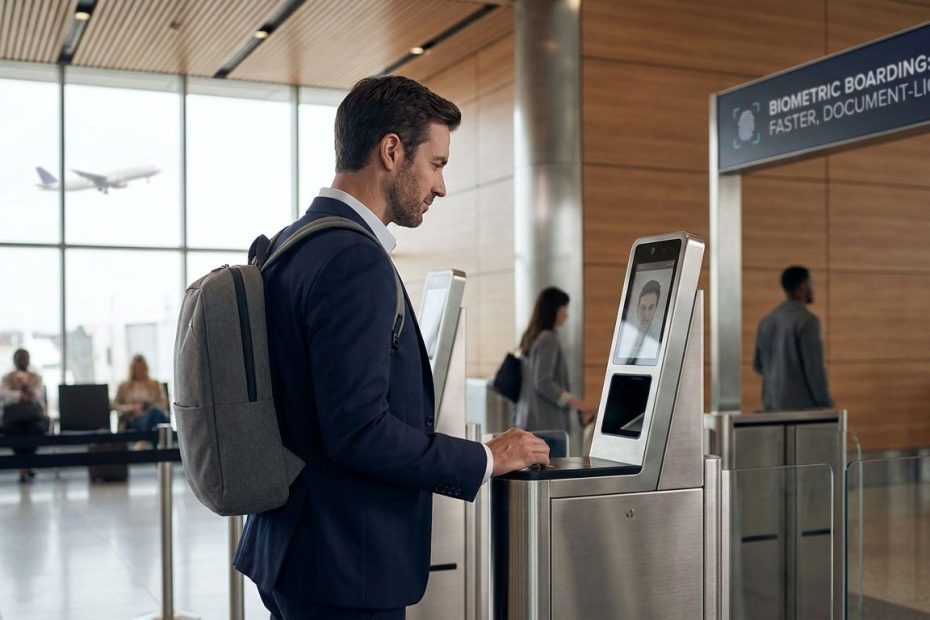
Biometric boarding is no longer a pilot concept you only notice on a few international routes. It is now part of a wider airport technology shift that is changing how you check in, clear security, board flights, and move through terminals with fewer document checks and more automated identity verification.
If you want to understand what is changing, where it is already live, and what it means for your next trip, this article gives you the practical view. You will see how facial matching, touchless identity programs, digital travel credentials, e-gates, and airline-led automation are turning air travel into a more document-light experience, with clear gains in speed, consistency, and convenience.
What Is Biometric Boarding, And How Does It Actually Work At The Airport?
Biometric boarding replaces a manual identity check with a face match. Instead of handing over a boarding pass and passport for a visual review, you step up to a camera, the system captures a live image, and that image is compared with a photo already linked to your travel record, often from a passport, visa, or prior government-held image. If the match succeeds, the boarding process moves forward in seconds.
From an operational standpoint, this matters because boarding is only one checkpoint in a larger chain. Airlines, airports, and government agencies have spent years trying to remove repeated document handling from the passenger journey. A traveler who checks in digitally, drops a bag at a self-service station, clears a touchless security checkpoint, and boards through a facial match creates a much smoother flow than one who stops to present documents at every handoff.
In the United States, a large share of international biometric boarding has been tied to systems used by United States Customs and Border Protection. The government’s traveler verification tools have moved far beyond a small experiment and now support identity verification at major air gateways. That scale is important because it shows airport biometrics are no longer niche technology installed for demonstration value. They are part of live passenger processing at national level.
The practical point for you is simple. Biometric boarding is best understood as one layer in a broader identity system. When people talk about the future of flying, they often focus on the boarding gate camera. The bigger shift is that the same identity method is moving into check-in, bag drop, security screening, lounge entry, border control, and automated gates across the terminal.
This is why the phrase “document-light travel” matters more than “paperless boarding.” The real change is not one faster moment at the gate. It is the steady removal of repeated identity checks that slow you down, create queues, and force staff to handle the same verification task again and again across the airport.
Is Biometric Boarding Mandatory, Or Can You Opt Out?
For most travelers in the United States, biometric boarding and related facial matching programs are generally optional, but the answer depends on the checkpoint, the agency involved, and the airline workflow in use at that airport. United States Customs and Border Protection says United States citizens may request a manual document check instead of using facial biometrics. The Transportation Security Administration also states that travelers can decline facial matching at security and use an alternative identity verification process.
Where many travelers get confused is in the overlap between government-run and airline-supported programs. A facial scan at an international departure gate is not the same thing as a touchless identity program at a domestic security lane. A camera at bag drop does not necessarily follow the same rules as a boarding gate camera. Those differences matter, especially if you want to know whether participation is voluntary or what backup process applies when you decline.
You should also expect inconsistency in how the policy is explained on the airport floor. Official rules can be clear on paper, yet frontline communication may vary by airport, by lane, and by employee training. That gap is one reason biometric travel still creates friction even when the underlying technology works well. Travelers are often less concerned about the scan itself than about whether they are given a plain, accurate explanation of their options.
The most practical move is to treat opt-out rights as real, but not as a reason to arrive unprepared. Carry your physical identification, keep your boarding pass accessible, and assume that manual verification may still be needed. That is especially important with airline-linked touchless identity programs, where a system outage, missing passport data, or profile mismatch can send you back to a standard document check.
From an airport operations view, opt-out is also a pressure test. A system that claims to be optional has to support the non-biometric path without delay, confusion, or visible penalty. If the manual lane is slow, poorly explained, or awkward to access, travelers will read that as soft compulsion even when the official policy says participation is voluntary.
Is The Transportation Security Administration Using Facial Recognition Now, And Where Is Touchless Identity Available?
Yes, the Transportation Security Administration is already using facial comparison technology for identity verification at certain checkpoints, and its Transportation Security Administration PreCheck Touchless Identity program has expanded through participating airlines and airports. This marks an important change in public understanding of airport biometrics. Many travelers still associate facial matching with border control or international departures, yet the technology is now part of domestic security workflows too.
Touchless Identity is designed for enrolled Transportation Security Administration PreCheck members who choose to participate through eligible airline programs. To use it, travelers generally need an active PreCheck membership, a valid passport, and airline profile information that matches government records. The system then uses facial matching to verify identity at the checkpoint, reducing the need to hand over identification in the usual way.
This shift matters because security is one of the most frequent friction points in the airport journey. When biometric verification moves into that part of the trip, the technology stops being a specialized border tool and starts becoming part of the routine passenger experience. That changes adoption patterns. Frequent fliers begin to see touchless identity not as a novelty, but as a convenience feature built into their normal travel habits.
You should also separate availability from uniform access. A program can be active across several airports and still depend on airline participation, airport equipment, enrollment status, and checkpoint configuration. A traveler may qualify for touchless processing on one itinerary and not on another. That does not mean the system failed. It means airport identity technology is still being rolled out through linked programs rather than one national, standardized passenger layer.
Data handling is another issue travelers watch closely. The Transportation Security Administration says that under normal conditions, facial comparison data used for identity verification is deleted after the process is completed, and some program-specific data in Touchless Identity is deleted within a limited period tied to scheduled departure. That matters operationally because trust in airport biometrics depends as much on retention policies and transparency as on speed at the checkpoint.
Which Airlines And Airports Already Use Biometric Boarding Or Facial Recognition?
Several major carriers and airports already use biometric tools in live passenger operations, though the exact experience differs by route and location. Delta Air Lines has been one of the most visible examples in the United States, with facial recognition used in parts of the international terminal experience in Atlanta and biometric boarding at selected gates in other hubs. American Airlines and United Airlines have also supported biometric boarding on international departures and participate in touchless identity efforts tied to government verification systems.
That pattern tells you something important about the market. Airlines are no longer building these tools as isolated branded experiments. The direction of travel is shared identity infrastructure, where airports, carriers, and public agencies connect through common verification systems. That is far more scalable than every airline creating a separate biometric process, and it makes adoption easier for airports that need one passenger flow to serve many carriers.
On the airport side, deployment is spreading from major international gateways into a wider set of terminals and use cases. You now see biometric tools connected not just to boarding, but also to bag drop, premium entry, automated exit, and security screening. The more these checkpoints connect to each other, the more useful the system becomes. A single camera at one gate is a narrow upgrade. A linked identity path from curb to gate changes how the terminal runs.
Industry bodies have also pushed for interoperability. The International Air Transport Association has promoted its One Identity program and contactless travel tools to help airlines access biometric services more easily. That matters because the next phase of airport technology is not simply adding more cameras. It is creating common standards that let a traveler move through different airports and carriers with fewer resets and less manual rechecking.
For you as a traveler, this means the question is no longer “Which one airport has facial recognition?” A better question is “How many parts of my trip can now run through the same identity layer?” Once security, boarding, border checks, and self-service stations begin to connect, the value of biometric travel becomes much more visible.
Does Biometric Boarding Actually Save Time, Or Is It Mostly Hype?
Biometric boarding can save time, but the benefit is strongest when the technology removes repeated document checks across the airport, not when it speeds up only one narrow moment at the gate. If a boarding pass scan and a passport glance already take only a few seconds, the gain from a facial match at boarding alone may feel modest. The bigger operational payoff comes when the same identity system supports check-in, bag drop, security, lounge access, border processing, and boarding in one connected sequence.
That distinction matters because airports often market biometrics as faster boarding, when the stronger argument is fewer interruptions. Travelers feel the value most when they stop digging for documents at every checkpoint and move through the terminal with fewer stops. Time savings then come not only from quicker verification but from a more stable passenger flow, shorter queue buildups, and less staff intervention when records are already connected.
Government and airline statements have pointed to real processing improvements in certain deployments. United States Customs and Border Protection has reported major reductions in kiosk processing time in programs tied to facial biometrics, and airline case studies have also linked biometric journeys to shorter wait times. Those gains are real, yet they are not universal. Airport layout, staffing, passenger mix, and how many touchpoints are connected all shape whether the traveler actually notices a difference.
You should think of biometric travel as an efficiency system, not just a speed feature. It improves throughput, reduces repetitive verification work, and helps airports manage volume without adding the same amount of staff at every checkpoint. That is why airports keep expanding these tools even when the visible traveler benefit at a single gate looks small. For the operator, reducing friction across the full journey matters more than shaving a few seconds from one scan.
There is also a reliability question. A process only feels faster when it works quietly in the background. If the system creates exceptions, false mismatches, unclear signage, or repeated fallback checks, any time gain can disappear quickly. The strongest deployments are the ones you barely notice because the identity check becomes part of the normal flow rather than a separate event.
How Accurate And Safe Is Airport Facial Recognition Technology?
Airport facial recognition is generally more accurate than many travelers assume, especially in tightly controlled travel settings where the system compares a live image against a small, known set of expected passengers. That is very different from an open-ended surveillance search. In airport operations, the comparison is usually limited to verifying that the person in front of the camera matches an existing travel record connected to that specific journey.
The National Institute of Standards and Technology has studied facial recognition in paperless travel and immigration scenarios, and its work shows a useful point: performance depends on setup, image quality, camera angle, lighting, and the structure of the gallery used for comparison. There is no single universal accuracy number that tells the whole story. A well-configured airport system in a controlled environment can perform very differently from a poorly tuned deployment in a crowded, less structured space.
For you, safety is not just a technical issue. It also includes where the image comes from, how long data is retained, who can access it, and what happens when the match fails. A system can be technically effective and still raise legitimate concerns if travelers do not get clear notice, if opt-out procedures are hard to use, or if retention policies are poorly explained. Operational accuracy and public trust are related, but they are not the same thing.
At security checkpoints, the Transportation Security Administration says facial identification technology is used to verify identity rather than to profile travelers for unrelated enforcement goals. That distinction matters, yet it does not remove the importance of transparency. When biometric systems spread quietly across the terminal, trust depends on visible signage, plain-language explanations, and a smooth alternative process for travelers who decline participation.
The strongest way to evaluate airport facial recognition is to separate technical performance from governance quality. Ask whether the system matches accurately, whether the process is clearly explained, whether fallback procedures work without friction, and whether data practices are disclosed in language a traveler can actually understand. When those four pieces align, biometric travel feels efficient. When they do not, even a technically strong system can create resistance.
What Comes After Biometric Boarding: Digital Identities, E-Gates, And Passport-Light Travel?
Biometric boarding is only the visible front edge of a broader move toward digital identity-based travel. Airlines, airports, and industry groups are working toward a model where your identity can be verified across multiple checkpoints without repeated presentation of physical documents. That does not mean passports disappear overnight. It means the airport journey increasingly relies on digital credentials, linked records, and automated verification in places where a staff member once checked every item by hand.
The International Air Transport Association’s One Identity work points toward that future by promoting a more connected passenger journey built around biometric verification and interoperable digital travel credentials. The value is not limited to convenience. A shared identity model can also reduce queue bottlenecks, improve staffing efficiency, and make airport processing more predictable during peak travel periods. Those are major operational gains for an industry that struggles whenever demand surges faster than terminal capacity.
E-gates are another sign of where the airport experience is heading. These systems automate identity checks and access control, often linking biometric verification with flight and document data. When deployed well, e-gates can move travelers through security or controlled-access points with less staff intervention and more consistent throughput. That turns identity verification into a managed flow rather than a series of manual pauses.
You can also expect digital identity programs to reshape the relationship between airlines and government agencies. Instead of treating each checkpoint as a separate check, the system can reuse verified identity data across the journey when policy and system design allow it. That is why the conversation is shifting from biometric boarding to contactless travel. The airport is becoming an identity environment, not just a place where a boarding gate happens to have a camera.
Passenger behavior is helping accelerate this shift. Many travelers will share biometric information when the exchange is simple and the convenience is obvious. When the reward is skipping repeated document checks, reducing queue friction, and moving through the terminal with less interruption, adoption tends to rise. The practical future of flying is not “show nothing.” It is “show less, stop less, and verify once across more of the journey.”
What Is Biometric Boarding In Air Travel?
- It uses your face to verify your identity at airport checkpoints.
- It can replace some manual boarding pass and document checks.
- It is expanding into security, bag drop, e-gates, and border processing.
- In many cases, travelers can still request manual verification.
Get Ready For A More Document-Light Trip
Airport technology is moving toward a travel experience where identity verification happens faster, more quietly, and at more points across your trip. Biometric boarding is part of that shift, but the larger story is the steady connection of check-in, security, boarding, and border control into one smoother flow. If you understand where these systems are already in use, when participation is optional, and how digital identity programs are expanding, you can move through the airport with fewer surprises and better control over your travel experience. The winners in this shift will be travelers who know the tools, carry backup documents, and recognize where convenience, automation, and airport operations are heading. The next time you fly, you are not just boarding a plane. You are stepping into a new identity system that is already changing the pace and shape of modern air travel.
References
- U.S. Customs and Border Protection — Biometrics: Enhanced Passenger Processing — https://www.cbp.gov/travel/biometrics/enhanced-passenger-processing
- U.S. Customs and Border Protection — Biometrics: Environments — https://www.cbp.gov/travel/biometrics/environments
- U.S. Customs and Border Protection — Statement for the Record on Assessing CBP’s Use of Facial Recognition Technology — https://www.cbp.gov/about/congressional-resources/testimony/statement-record-assessing-cbps-use-facial-recognition-technology
- Transportation Security Administration — TSA PreCheck Touchless ID — https://www.tsa.gov/precheck/touchless-id
- Transportation Security Administration — Is TSA using facial identification comparison technology to profile and deport passengers? — https://www.tsa.gov/travel/frequently-asked-questions/tsa-using-facial-identification-recognition-technology-profile
- Transportation Security Administration — TSA eGates public-private partnership enhances traveler experience — https://www.tsa.gov/news/press/releases/2025/08/19/tsa-egates-public-private-partnership-enhances-traveler-experience
- International Air Transport Association — One ID — https://www.iata.org/en/programs/passenger/one-id/
- International Air Transport Association — IATA’s Contactless Travel Directory Eases Airline Access to Biometric Services — https://www.iata.org/en/pressroom/2025-releases/2025-04-07-01/
- International Air Transport Association — What’s Holding Back Digital Travel? — https://www.iata.org/en/pressroom/opinions/whats-holding-back-digital-travel/
- International Air Transport Association — IATA’s Global Passenger Survey Reveals Mobile and Digital ID as the Future of Travel — https://www.iata.org/en/pressroom/2025-releases/2025-11-05-02/
- Delta Air Lines — Innovation@Delta — https://www.delta.com/content/www/en_US/traveling-with-us/innovation.html
- American Airlines — TSA PreCheck Touchless ID — https://www.aa.com/i18n/travel-info/security/tsa-precheck-touchless-id.jsp
- National Institute of Standards and Technology — Face Recognition Vendor Test Part 7: Identification for Paperless Travel and Immigration — https://www.nist.gov/publications/face-recognition-vendor-test-frvt-part-7-identification-paperless-travel-and
- Reddit — disheartening experience at the airport today — https://www.reddit.com/r/privacy/comments/1runlx0/disheartening_experience_at_the_airport_today/

Robert Wilkos is the co-founder of VIPJets.com and a private aviation executive leading luxury charter services through a global network of 10,000+ aircraft. He champions rigorous Wyvern/ARGUS safety standards, 24/7 concierge support, and flexible options like the 25-Hour Jet Card, along with ground and air-medical transport.