
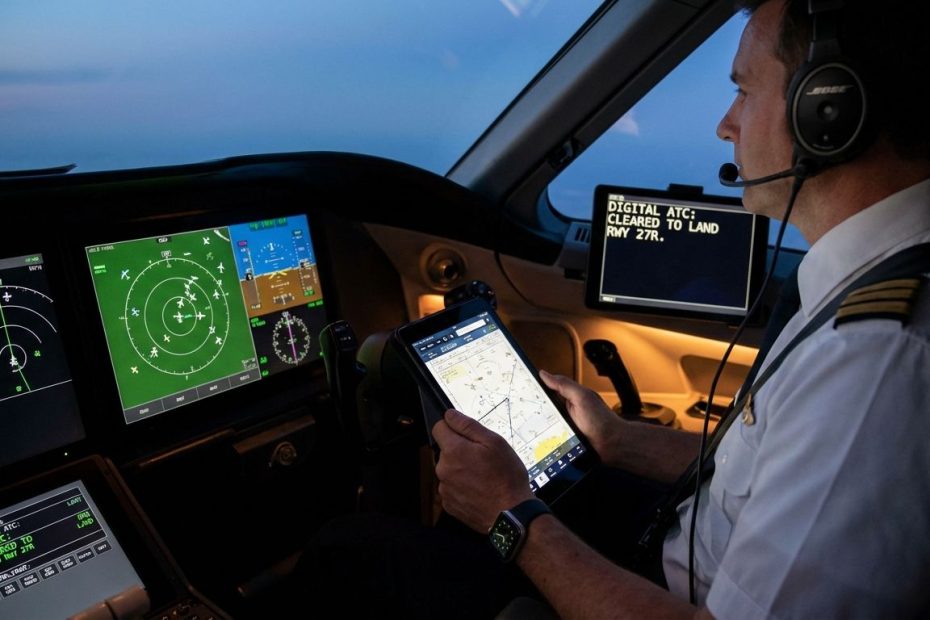
You see airline safety and efficiency improve fastest when surveillance gets more precise, communications get less ambiguous, and operational decisions get driven by fresh data instead of stale assumptions. The five technologies doing the most work today sit right in that lane: ADS-B, digital ATC messaging (Data Comm/CPDLC), EFBs on the flight deck, predictive maintenance, and turbulence data-sharing platforms.
This article walks you through what each technology does in day-to-day airline operations, what changes you can measure, and what still breaks when the human workflow around the tech is weak.
What Is ADS-B, And How Does It Make Flying Safer And More Efficient?
ADS-B, Automatic Dependent Surveillance–Broadcast, gives air traffic control and nearby aircraft a much sharper picture of where you are, where you are going, and how quickly that situation is changing. You broadcast your GPS-derived position and other data, and the system can deliver traffic and weather services back to the cockpit when you are equipped for ADS-B In. The operational change is simple: the system updates faster and covers areas where radar coverage is limited, which tightens situational awareness for controllers and pilots.
From a safety standpoint, you get earlier conflict recognition, better traffic awareness, and more dependable surveillance in places where terrain, distance, or infrastructure makes radar weak. From an efficiency standpoint, better surveillance supports better spacing strategies and more predictable routing, which matters when the system is busy and controllers are trying to keep the flow stable. That shows up as fewer workarounds, fewer vectors that burn time, and fewer “keep it tight and safe” compromises that quietly cost fuel. ADS-B also strengthens the shared mental model between cockpit and ATC, which reduces the odds of surprises when the plan changes late.
If you are thinking like an operator, the bigger win is consistency. When surveillance is reliable, you can plan closer to the performance you sold, and you can recover faster when weather or volume bends the schedule. That reduces secondary effects, gate holds, missed connections, crews timing out, and maintenance teams inheriting a late-night arrival that was avoidable. ADS-B is not glamorous to passengers, but it is foundational to the modern airspace performance you want to run.
How Does FAA Data Comm (CPDLC) Reduce Pilot-Controller Errors And Delays?
Data Comm, often discussed in the same breath as CPDLC, moves key air traffic communications from congested voice channels to digital messages. You still fly the airplane and you still comply with ATC, yet the instruction delivery becomes cleaner and less prone to the classic readback-hearback failure modes that show up on bad days. The value is strongest when clearances are long, complex, revised multiple times, or delivered in a radio environment where multiple aircraft step on each other.
Operationally, you are trading “copy this fast, repeat it back, hope everyone heard it correctly” for a workflow where the clearance is presented digitally and can be managed more deliberately. That reduces frequency congestion and gives controllers and pilots a more dependable exchange for items that do not need the immediacy of voice. The measurable payoff is fewer communication-induced delays and fewer communication-induced errors, which is a safety and efficiency improvement that scales across the National Airspace System rather than staying limited to one airline’s cockpit.
For airline leadership, Data Comm also helps standardize how crews handle revisions. You can build procedures around message management, acceptance discipline, cross-checking, and integration with flight deck systems, then audit it the same way you audit stabilized approaches or checklist compliance. When teams execute that consistently, you lower workload spikes at the exact moments when crews also manage taxi complexity, deicing, reroutes, and late gate pushes. That is where errors breed, and that is where digital comms earn their budget.
Are EFBs (iPads/Electronic Flight Bags) Actually Approved, And How Do They Improve Safety?
EFBs are widely used, and FAA guidance exists for operators and pilots who want to replace required paper information and use hosted databases and software applications as EFB functionality. The key operational reality is that an EFB is not “an iPad,” it is a controlled information system with currency expectations, usage discipline, and failure planning. When you treat it that way, you reduce chart errors, speed up access to performance and limitation data, and reduce cockpit clutter that causes missed items and poor cross-checking.
For Part 91 operators, FAA AC 91-78A lays out how to remove paper aeronautical charts and other documents from the cockpit through portable or installed displays, and it clarifies that the AC provides acceptable means of compliance rather than a mandatory rule. Practically, this pushes you toward explicit decisions: what applications are approved for what tasks, how updates are verified, what the minimum device configuration is, and what you do when the device fails at a critical phase. When those decisions are made on purpose instead of by habit, safety improves fast.
If you want the plain-language answer to the “is my iPad legal” question that pilots keep asking, the cleanest summary is that a blanket answer does not exist because legality depends on operation type and jurisdiction, and the responsibility sits with the pilot and the operation. That matches how the industry actually functions: airlines and commercial operators formalize EFB policies, training, and redundancy expectations, and individual pilots still carry the final responsibility to comply. When you align policy, training, and real cockpit habits, EFBs become a reliability upgrade instead of a single point of distraction.
How Does AI And Predictive Maintenance Cut Cancellations Without Compromising Safety?
Predictive maintenance works when you stop treating maintenance as a reactive scramble and start treating it as a forecast problem with operational consequences. Modern fleets generate volumes of health and usage data, and analytics can detect patterns that correlate with a coming failure or a recurring operational defect. That lets you schedule maintenance at a time and location that protects the network, instead of discovering the issue at pushback, at takeoff roll, or on arrival when the next leg is already boarding. The core safety point is straightforward: you still comply with approved maintenance programs and airworthiness requirements, yet you reduce the odds of a defect turning into an operational disruption.
On the performance side, Airbus describes predictive monitoring under Skywise Fleet Performance+ as operational for around 40 customers operating around 1,500 aircraft. That is important because it signals maturity: the technology is not a lab project, it is embedded in real airline maintenance and reliability programs. Airbus also points to avoided cancellations through that monitoring, which is exactly the metric that matters to an airline trying to protect schedule integrity while keeping safety margins intact.
From an airline leadership lens, the “AI” part is less important than the workflow discipline. Predictive systems still depend on sensor coverage, configuration control, correct fault reporting, and clean handoffs between line maintenance and engineering. If data entry is sloppy or technicians do not trust the signal, the tool becomes background noise and the organization slips back to reactive mode. When reliability teams treat the output as a decision-support input and track the closeout quality with the same seriousness as operational metrics, cancellations drop and dispatch reliability rises without cutting corners.
What Tech Are Airlines Using Right Now To Predict And Avoid Turbulence And Reduce Injuries?
Airlines increasingly use real-time turbulence reporting and data-sharing platforms to support better route and altitude decisions. The job is not to eliminate turbulence, the job is to reduce exposure to the worst of it and to manage cabin risk with better timing, better routing options, and earlier awareness. When dispatchers and flight crews see more accurate ride reports in the right place in the workflow, they can act sooner, keep service safer, and reduce the chance of injuries.
IATA’s Turbulence Aware platform is a concrete example with meaningful scale: it has over 25 airlines contributing and consuming data through more than 2,600 aircraft, and it generated 38 million reports in a single year. Those are operationally significant numbers because they imply route density and repeatability across the global network. When you get that many reports, you reduce guesswork and you reduce the lag between “someone hit it” and “you now know where it is.”
IATA also frames the operational value in terms pilots and dispatchers recognize: real-time, accurate reporting helps choose optimal flight paths, avoid turbulence, and fly at optimum levels to improve fuel efficiency and reduce emissions. The airline benefit is dual-use: fewer injuries and fewer cabin disruptions, plus fewer fuel penalties from late tactical changes. If your operation struggles with passenger claims, crew injuries, and service interruptions linked to turbulence, this category of technology is no longer optional if you want predictable performance.
Do Airlines Use “Waze For Flights” Route Optimization, And Does It Actually Save Fuel?
Airlines do use decision-support tools that behave like continuous route optimization, and they generally work as advisory systems. The cockpit remains in control, ATC remains the authority for clearances, and dispatch remains responsible for the flight plan and operational risk management. The operational value is that the tool keeps refreshing the options using live winds, ride conditions, network constraints, and aircraft performance, then highlights changes that could save time and fuel if ATC and the crew can execute them. That is how you turn data into a concrete, operational decision rather than a nice dashboard.
A public, plain-language description appears in a flight deck technology post discussing an AI-driven system called SmartRoutes that continuously updates to make route suggestions that can shave time off a trip and save fuel. Even when a specific product name varies by airline, the pattern matches what modern operations teams build: live monitoring plus recommendations that fit the airline’s risk rules. If your airline is not doing some form of this yet, flight planning is leaving performance on the table whenever winds and ride conditions shift faster than your flight plan update cycle.
The executive-level caution is that route optimization is only as good as the integration. If recommendations arrive in the wrong place, too late, or without a clean “why,” crews ignore them and dispatch distrusts them. When you integrate route suggestions into dispatch release updates, ACARS messaging, and flight deck review habits, you can measure acceptance rates and quantify fuel and block-time changes with less debate. When the tool is disconnected from daily workflows, it becomes an expensive notification system that nobody acts on.
What’s The #1 Hidden Risk With These Technologies According To Pilots And Maintenance Teams?
The most common operational failure mode is not the technology itself, it is weak execution around data quality, currency control, and human factors. Crews and technicians will tolerate new tools when the tools reduce workload and reduce rework. They will reject the tools when the tools add steps, add uncertainty, or deliver outputs that do not match the reality they see. That gap shows up in small behaviors: skipped cross-checks, late updates, copy-paste thinking, and informal workarounds that spread across a base in weeks.
EFBs are a clean example. The safety upside depends on current data and consistent usage discipline, plus a planned response when devices fail, overheat, or lose power at the wrong time. FAA guidance exists to support paper replacement and hosted database usage, yet the operator still has to decide what “good” looks like on the line and train to it. When you enforce currency verification, redundancy expectations, and standardized brief flows, EFBs lift performance without making crews chase the device.
Predictive maintenance carries the same risk in a different uniform. The analytics can flag what matters, yet someone still has to code the defect correctly, confirm the fix correctly, and close the loop correctly so the system learns. Airbus explicitly discusses issues airlines recognize, including reducing “No Fault Found” loops through better monitoring and analytics, which is the kind of reliability work that separates high-performing operators from constant disruptions. If reliability data is messy, the tool produces noise, and leadership starts making budget decisions based on mistrust instead of performance.
Top Technologies Improving Airline Safety And Efficiency
- ADS-B: faster, more reliable surveillance and cockpit traffic awareness
- Data Comm/CPDLC: digital clearances that reduce radio errors and congestion
- EFBs: current charts, performance tools, and controlled cockpit information
- Predictive Maintenance: earlier fixes that prevent delays and cancellations
- Turbulence Data Sharing: better routing and safer cabin risk management
Put These Technologies To Work On Your Next Operational Review
If the goal is safer operations with fewer delays, focus on what these tools change in everyday execution: surveillance quality, communication clarity, cockpit information control, maintenance predictability, and real-time ride intelligence. You will get the best returns when standard operating procedures, training, and auditing match the technology’s strengths, and when teams treat data quality as operational safety equipment. ADS-B and Data Comm raise system performance, EFBs tighten cockpit accuracy, predictive maintenance protects dispatch reliability, and turbulence platforms reduce injuries while supporting smarter routing. The competitive edge comes from integrating these tools into workflows crews and controllers already trust, then measuring outcomes with the same discipline used for on-time performance and safety metrics.
References
- FAA, NextGen: https://www.faa.gov/newsroom/nextgen
- FAA, ADS-B Benefits: https://www.faa.gov/air_traffic/technology/equipadsb/capabilities/benefits
- FAA, Data Communication Program (DataComm): https://www.faa.gov/air_traffic/technology/DataComm
- FAA, AC 91-78A Use of Electronic Flight Bags: https://www.faa.gov/regulations_policies/advisory_circulars/index.cfm/go/document.information/documentID/1042512
- ForeFlight Support, iPad EFB Legality: https://support.foreflight.com/hc/en-us/articles/204455565-Are-iPad-EFB-s-legal-to-use-in-flight
- Airbus, Keeping The Fleet Flying (Predictive Maintenance): https://www.aircraft.airbus.com/en/newsroom/news/2024-10-keeping-the-fleet-flying
- IATA, Turbulence Aware Platform Expansion: https://www.iata.org/en/pressroom/2024-releases/2024-12-10-04/
- IATA, Navigating Turbulent Skies With Certainty: https://www.iata.org/en/pressroom/opinions/navigating-turbulent-skies-with-certainty/
- Reddit, Technology In The Flight Deck (SmartRoutes mention): https://www.reddit.com/r/fearofflying/comments/1dzgqbw/technology_in_the_flight_deck/

Robert Wilkos is the co-founder of VIPJets.com and a private aviation executive leading luxury charter services through a global network of 10,000+ aircraft. He champions rigorous Wyvern/ARGUS safety standards, 24/7 concierge support, and flexible options like the 25-Hour Jet Card, along with ground and air-medical transport.